Geological setting and target areas
The exploration model is based on the relationship between graphitic schists, metabasite intercalations, quartzitic mica schists and long-lived shear zones.
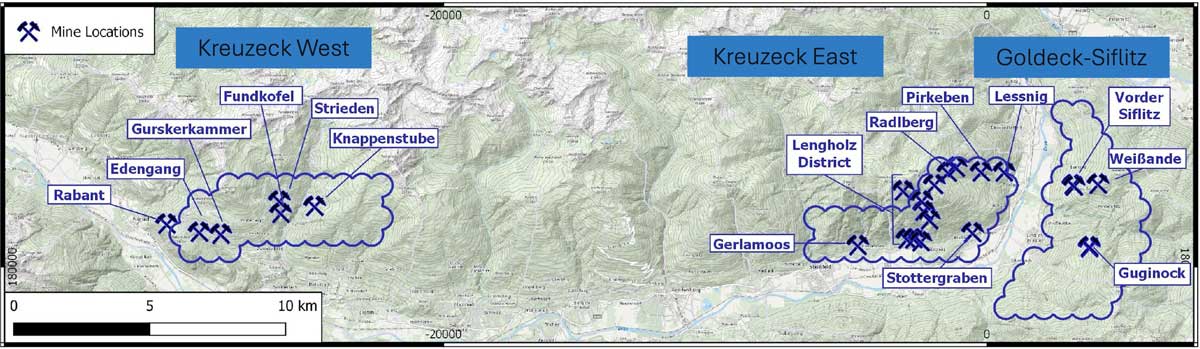
– Rabant: the western, antimony-dominant target area. Historical records identify workings including Hermann Stollen, Johanni-Grube, Mariengrube and Edengang. Historical production figures are unverified and are used only as context and target-generation information.
– Gurskerkammer: the central gold-antimony target area. Historical descriptions place the workings in a graphitic and metabasitic corridor associated with a major shear zone.
– Fundkofel: the principal gold-arsenopyrite vein target. Historical geology records discordant quartz-sulphide veins and workings including the Funder, May and Maffei galleries.
– Strieden-Knappenstube: an eastern sulphide target area. Historical descriptions refer to stratabound to semi-stratabound sulphide mineralisation, and legacy self-potential and soil-geochemistry work provides target-generation data.
Exploration status and proposed work
Modern work has mainly comprised data compilation, site visits, limited surface sampling and review of historical information. The proposed program is staged and decision-gated. It begins with data validation, access review, georeferencing of historical workings, geological mapping and geochemical sampling. Geophysics and scout drilling would follow where earlier work establishes coherent targets and access and permitting requirements can be met.
Project status notice
Kreuzeck West is an early-stage exploration project. Historical estimates, production statements and reported grades have not been independently verified for current reporting and are used as exploration and target-generation information only.