Geological setting and target areas
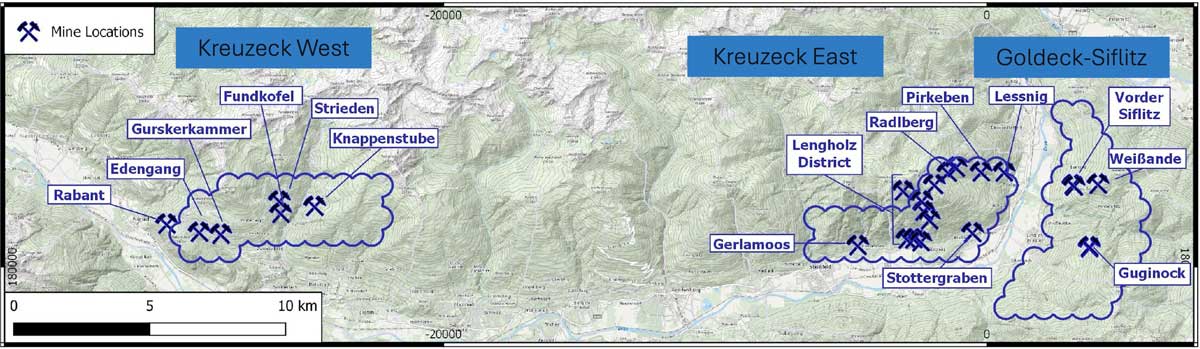
Kreuzeck East is an antimony-dominant to transitional expression of the broader gold-arsenic-antimony mineral system. Antimony mineralisation is associated with graphite-rich mica schists, quartz phyllites and marble-adjacent settings along the Lessnigbach shear system. Gold mineralisation is described principally as auriferous arsenopyrite and quartz-sulphide veins in the Lengholz area and related southern workings.
– Lessnig-Radlberg corridor: the principal antimony target, aligned broadly with the Lessnigbach shear zone and containing a cluster of historical stibnite workings.
– Pirkeben, Radlberg and Pragen: antimony occurrences on or near the same structural corridor, used to assess whether mineralisation extends beyond one historical mine site.
– Lengholz: the principal gold-bearing component, described historically as a system of gold-arsenopyrite and quartz-sulphide veins.
– Stottergraben and Gerlamoos: secondary historical working areas with incomplete historical records of gold, silver and lead mineralisation.
Exploration status and proposed work
Modern work has mainly involved desktop compilation, project-scale review and limited field activity. The proposed staged program begins with historical-data compilation, access confirmation and georeferencing, followed by geological and structural mapping and multi-element geochemical sampling. Geophysical surveys are intended to test the mapped corridor, with drilling considered after target geometry and geological context have been established.
Project status notice
Kreuzeck East is an early-stage exploration project. Historical grades, production statements, delivered-ore figures and stope-scale estimates are described in the prospectus as non-JORC historical information, have not been independently verified by the Independent Geologist and indicate mineralisation tenor only.